What the Anion Gap Measures
The anion gap is a reliable way to evaluate serum electrolytes and think through acid-base disorders. It shows the relationship between measured cations and anions in the blood, helping clinicians identify hidden, or unmeasured anions, that may signal a metabolic derangement. In everyday use, the Anion Gap Calculator acts as an interpretation guide for serum chemistry, not just a math tool.
At its core, the anion gap is a marker of electrolyte balance and acid-base interpretation. The most common measured components are sodium, chloride, and https://pastelink.net/qtl8k73h bicarbonate, with potassium sometimes included depending on the equation or lab method. Because the body must maintain electrical neutrality, any gap between measured positive and negative charges usually represents ions not directly reported by standard laboratory values.
That makes the anion gap a important diagnostic clue in systemic acidosis. A widened gap may point to excess acids or retained acids, while a low result can point to changes in protein levels, analytical issues, or less common causes involving unmeasured ions. Interpreting the result requires clinical context, because the same number can signify different things in different settings.
How to Compute the Anion Gap
The standard anion gap formula is:
Anion gap = sodium - (chloride + bicarbonate)
Some methods also include potassium, using:
Anion gap = (sodium + potassium) - (chloride + bicarbonate)
Most calculators use the first version because potassium contributes less to the total calculation in routine practice. An Anion Gap Calculator typically uses the main calculator inputs from an electrolyte panel or basic metabolic panel: sodium, chloride, bicarbonate, and sometimes potassium. Once entered, it quickly produces the calculated gap and supports faster comparison with the expected range.
For example, if sodium is 140, chloride is 102, and bicarbonate is 24, the anion gap is 14. That number alone does not diagnose a condition, but it can direct the next step in evaluation. When the gap is elevated, the clinician should consider whether the patient has a high burden of unmeasured anions, often from acid accumulation.
Potassium may somewhat increase the numeric result when included, but the clinical interpretation usually remains similar. The key is consistency: use the same formula style when trending results across time or comparing them with prior laboratory values.
Standard Anion Gap Range and Reference Values
The typical range for the anion gap differs by laboratory and analyzer. This is why the reference range should always be checked against the reporting lab rather than assumed from a universal cutoff. Differences in methods, ion-selective electrodes, and reporting conventions can create meaningful laboratory variation.
In many settings, a traditional reference interval is roughly 8 to 16 mEq/L without potassium, though some labs report different limits. The exact cutoff is less important than whether the value is above or below that lab’s stated range and whether the result fits the patient’s condition. A normal anion gap does not exclude disease, and an abnormal number does not explain the cause by itself.
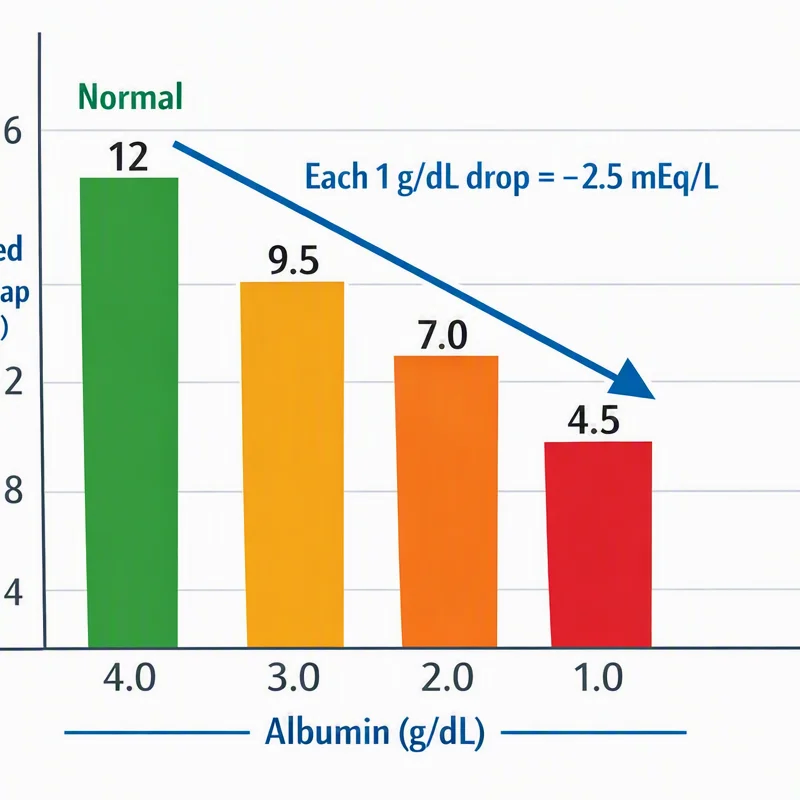
Albumin also matters because it is a major negatively charged protein in plasma. Lower albumin can reduce the measured gap and make a clinically important high-gap disorder appear less dramatic. That is one reason the anion gap should be interpreted as part of a broader chemical panel assessment rather than in isolation.
View the number as a moving target influenced by assay differences, protein levels, and the underlying patient context. The most useful approach is to compare the result with the lab’s own reference interval, then decide whether anion gap correction is needed.
High Anion Gap Causes
A high anion gap often suggests build-up of acidic substances or acid-related compounds that are not measured directly. This pattern often points to metabolic acidosis, especially when bicarbonate is low and symptoms are consistent with an acid load. The classic concern is that extra unmeasured anions are displacing bicarbonate as buffering capacity is consumed.
Common causes include lactic acidosis, ketoacidosis, renal failure, and toxic alcohols. In lactic acidosis, lactate rises because of tissue hypoperfusion, hypoxia, seizures, severe infection, or other metabolic stress. In ketoacidosis, excess ketone bodies widen the gap, often in diabetes, starvation, or alcohol-related illness.
Renal failure can raise the anion gap when acids are not adequately excreted and retained acids accumulate. In that setting, impaired clearance contributes to renal impairment and progressive metabolic acidosis. Toxic alcohols such as methanol and ethylene glycol are especially important because they may produce a significant gap before other findings become obvious. This is where an elevated gap becomes a serious clue to toxin exposure.
Not every high gap is due to a single cause. Mixed disorders can coexist, and the degree of elevation may be blunted by low albumin. The best approach is to combine the anion gap with the full electrolyte pattern, history, and symptoms. That broader view is what converts a lab number into a clinically useful signal.
Decreased Anion Gap Causes
A low anion gap is less common but still important. One frequent explanation is hypoalbuminemia, since albumin supplies negatively charged proteins to the blood. When albumin falls, the apparent gap drops as well, even if the true acid-base problem is not low. This is why a low number should not be ignored automatically.
Another cause is multiple myeloma, where abnormal proteins can alter charge balance and affect measured values. In some patients, positively charged paraproteins reduce the calculated gap and serve as an early clue to a plasma cell disorder. That makes the result more than a simple calculation; it can become a trigger for further evaluation.
Lab error is also frequent enough to consider first, especially if the value is unusual or inconsistent with prior results. Analytical problems, specimen issues, or transcription errors can all produce incorrect results. Repeat testing is often the simplest way to confirm whether the low value is real.
Finally, unmeasured cations can lower the gap. These may include excess lithium or other unusual positively charged substances. In practice, the differential diagnosis of a low gap should begin with albumin, then move to measurement issues and less common clinical causes. A careful look at the full electrolyte panel is important.
Modifying the Anion Gap for Albumin
Correction for albumin helps refine the result when serum albumin is low. Because albumin is a primary contributor to the negative charge in plasma, low levels can hide a clinically meaningful elevation. The corrected anion gap approximates what the gap might be if serum albumin were normal.

A common approach is to add a fixed amount to the measured anion gap for each reduction in albumin below the usual reference point. Different formulas may be applied, so the exact adjustment may differ by institution. The goal is not mathematical perfection but more accurate acid-base interpretation when protein levels are altered.
This is especially useful in patients with malnutrition, liver disease, inflammation, or critical illness where albumin is low. In those settings, the albumin-adjusted result may expose a hidden high gap that was masked by low protein binding. That can change how the clinician thinks about the patient’s metabolic acidosis and whether additional workup is needed.
Albumin correction should be seen as part of an anion gap correction strategy, not a replacement for clinical judgment. If the corrected result is still high, it supports concern for true acid accumulation. If it becomes normal, the low albumin may account for much of the abnormality.
Applying an Anion Gap Calculator within Clinical Practice
An Anion Gap Calculator proves most helpful when it is part of everyday assessment of the basic metabolic panel or electrolyte panel. The key calculator inputs are clear, but the clinical value stems from how the result is understood. The calculator offers a quick number; the clinician supplies context.
In practice, the result helps structure the differential diagnosis. A high gap turns attention toward metabolic acidosis, while a low gap prompts review for hypoalbuminemia, analytical problems, or unusual protein or cation effects. The result becomes a quick screen for abnormalities in the body’s electrolyte balance and acid-base physiology.
Useful interpretation starts by asking a few questions: Is bicarbonate low? Is there evidence of shock, diabetes, kidney disease, or ingestion? Is albumin reduced? Are there signs of renal impairment or suspected toxin exposure? These questions keep the attention on the patient rather than the formula alone.
Effective use of an Anion Gap Calculator also means understanding trends. A rising gap may be more significant than one isolated value. Serial checks can uncover worsening systemic acidosis or response to treatment. That makes the calculator part of a broader monitoring strategy, not just a one-time computation.
Limitations & Common Errors
As with any lab-based method, the anion gap is affected by measurement error. Even minor inaccuracies in sodium, chloride, or bicarbonate can shift the calculated value. That is why unexpected values should be reviewed in the context of the full serum chemistry and repeated when needed.
Pseudohyponatremia can falsely alter the calculation if sodium is underestimated because of severe hyperlipidemia or hyperproteinemia. Since sodium is a key component of the formula, this error can change the apparent gap. The result may look abnormal even though the underlying physiology is different.
Chloride interference is another source of error. Certain substances or analytic methods can cause chloride to be measured inaccurately, which directly affects the calculated gap. A falsely elevated chloride can make the gap appear low even when acid accumulation is present.
Another important limitation is that the anion gap is not a direct measure of every acid. For example, beta-hydroxybutyrate may be the dominant ketone in some patients, but it is not routinely measured on standard panels. That means a clinically significant ketoacid state can exist even if the gap is only modestly changed early on. Understanding these limitations improves both sensitivity and specificity in real-world interpretation.
When to Seek Further Evaluation
Further evaluation is warranted when the anion gap is clearly abnormal, when symptoms suggest serious illness, or when the result does not match the patient’s presentation. In those cases, an arterial blood gas or venous blood gas can provide additional insight into pH, carbon dioxide, and compensation. These tests help verify the presence and severity of acid-base disturbance.
Lactate should be checked when lactic acidosis is a concern, especially in patients with poor perfusion, infection, hypoxia, or unexplained metabolic acidosis. If ketones are suspected, targeted measurement of ketone bodies can determine the cause. If ingestion is possible, toxicology evaluation may be needed because toxic alcohols can be time-sensitive and dangerous.
The choice to proceed should always match clinical context. A small change in an otherwise stable patient may need only monitoring and repeat testing. A marked high gap in a sick patient, however, requires prompt evaluation because it may reflect a major metabolic derangement. The calculator helps spot the signal, but the bedside assessment determines the level of urgency.
Frequently Asked Questions
What is an anion gap calculator used for?
An Anion Gap Calculator is used to promptly assess serum electrolytes and estimate whether there is an abnormal distribution of measured and unmeasured ions. It helps identify possible acid-base disorders, especially metabolic acidosis, and can point toward causes such as lactic acidosis, ketoacidosis, or renal failure. It is best used as part of a broader clinical assessment.
How do you calculate the anion gap from serum electrolytes?
Use the anion gap formula: sodium minus the sum of chloride and bicarbonate. Some formulas also include potassium, but many routine calculations do not. The inputs usually come from a basic metabolic panel or electrolyte panel. The result is then compared with the lab’s reference range or normal range.
What does a high anion gap mean?
A high anion gap usually suggests build-up of unmeasured anions from acids in the blood. Common causes include metabolic acidosis, lactic acidosis, ketoacidosis, renal failure, and toxic alcohols. The result is a strong diagnostic clue, but it must be interpreted with symptoms, history, and other laboratory values.
What can cause a low anion gap?
A low anion gap is most often due to hypoalbuminemia or lab error. It can also be seen with multiple myeloma or other sources of unmeasured cations. If the value is unexpected, repeating the test and reviewing the full serum chemistry is a good first step.
Is it necessary to consider the anion gap get corrected for albumin?
Indeed, albumin correction is often beneficial when serum albumin is low. As albumin affects the charge balance in blood, a low albumin level can hide a true high anion gap. Using a albumin-corrected anion gap can improve interpretation, especially in patients with malnutrition, systemic inflammation, or other conditions affecting protein binding.